The Customer Solution Brief (Post 9 of 10)
The most common objection to the Customer Solution Brief is that the maintenance burden is too high. Organizations that have lived through documentation projects know the pattern: something is built, launched with good intentions, used for a few months, and then slowly abandoned as the business moves on and the document fails to keep pace. The brief becomes outdated. People stop trusting it. They stop using it. And eventually someone asks whether the brief is still current and nobody can say with confidence.
This is a real failure mode, and it happens in organizations where the brief is treated as a content artifact rather than an operating artifact. The distinction matters. A content artifact is something that gets written, reviewed, and published, whether that’s a white paper, a case study, or a positioning document. It’s accurate as of the date it was written and becomes less accurate over time through no one’s fault in particular. An operating artifact is something that gets used in the course of running the business and changes because the business changes. The brief is the second kind. If it’s maintained the right way, it stays current with almost no dedicated maintenance effort.
What Actually Makes a Brief Go Stale
To understand how to keep the brief current, it helps to understand why briefs go stale in the first place. There are three root causes, and they correspond to three distinct triggering events in the business.
The first is product change. When a new capability is launched that affects how value is created for a customer type, the brief’s value thesis and capabilities sections need to reflect it. When a capability is deprecated or significantly changed, the same is true. Product changes are the most frequent trigger and usually the easiest to manage, because they happen on a known schedule. A brief update process tied to product releases is the most reliable way to stay current on this dimension.
The second is market change. When the competitive landscape shifts in a way that changes what prospects care about or what the company needs to lead with in the sales motion, the brief’s value thesis and demo guidance need to reflect that. When customer expectations in a segment change, because a competitor has raised the bar, because regulation has shifted, because economic conditions have changed how buyers think about investment, the success definition and implementation guidance may need to adjust. Market changes are less predictable than product changes but usually surface clearly in win-loss patterns and in the feedback from experienced sales reps about what they’re hearing in the field.
The third is organizational learning. This is the most valuable and most frequently ignored trigger. When customer success accumulates evidence that a success definition was wrong, that the account health model wasn’t predicting churn the way the brief implied it would, that’s a signal that the brief needs to change. When implementation discovers that a configuration pattern the brief recommends consistently produces difficulty with a certain type of integration, that’s a signal. When sales wins a pattern of deals that don’t fit any existing customer type, that might be the signal that a new brief is warranted. The learning loop is only as valuable as the organization’s willingness to update the brief when the learning is clear.
The Artifact Traceability System
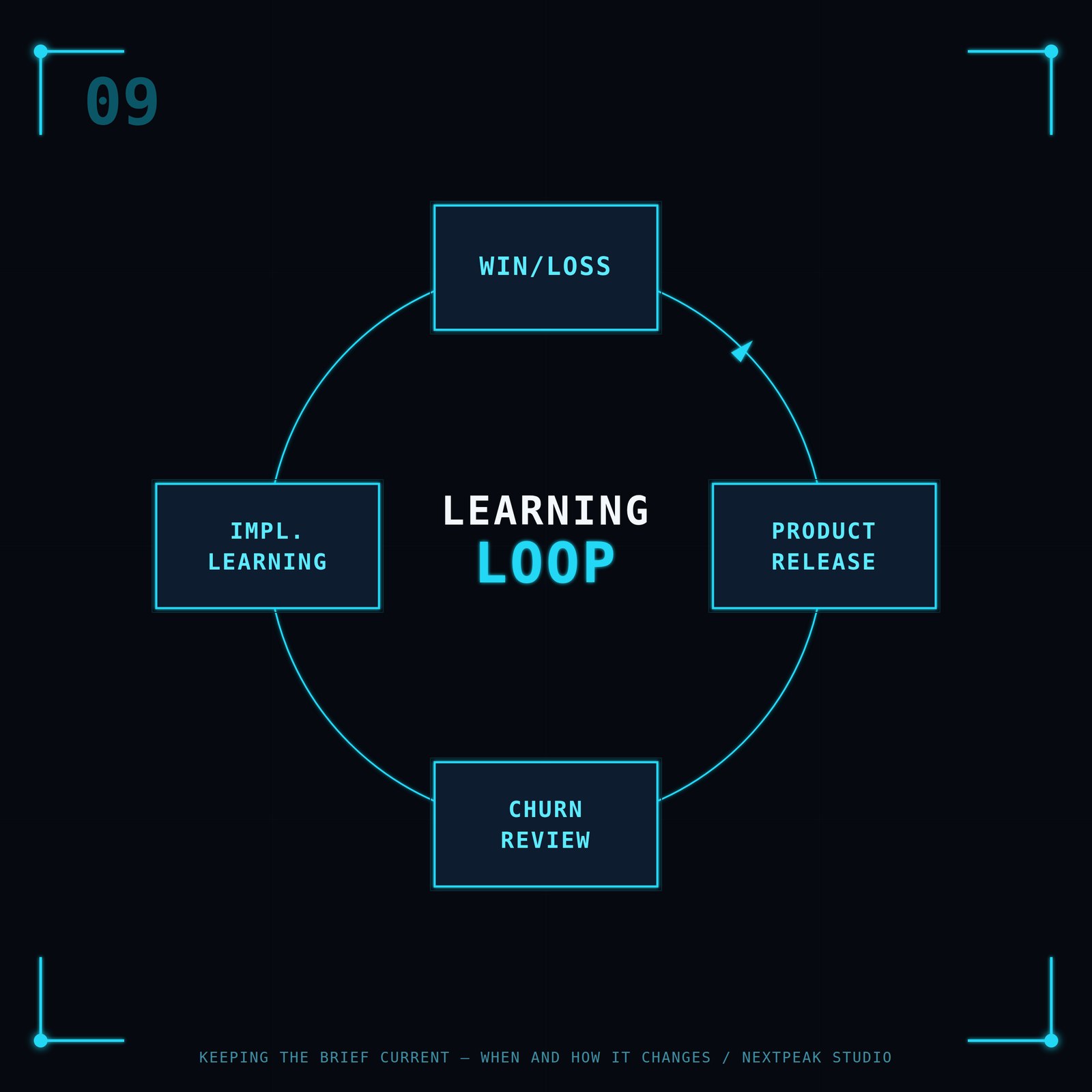
The most effective way to keep briefs current without creating a maintenance burden is to build traceability between the briefs and the events that should trigger updates. Rather than a new category of documentation, this is a set of explicit links between existing business processes and the brief sections they inform.
When a product capability is launched, the release process should include a step that asks whether this affects any customer type brief, and if so, the relevant sections get updated before the capability goes live rather than scrambled into place after the fact. When a significant win or loss is debriefed, the debrief should include the question of whether the deal behaved the way the relevant customer type brief predicted, and if not, what that means for the brief. When a customer churns, the post-mortem should include a review of whether the brief’s selection criteria and implementation guidance would have predicted the failure, and if so, whether the selection process failed or the brief itself needs to be refined.
These questions add minutes to processes that are already happening. They don’t require a new governance process or a brief review committee. They require that the brief is treated as a living operating document and that the people closest to the business, in sales, in implementation, in customer success, understand that their experience is the primary input into keeping it accurate.
Who Owns the Brief
The question of ownership is practical and often contested. The brief spans multiple functions, which creates ambiguity about who is responsible for keeping it current. The answer that works operationally is that the brief has a primary owner, typically someone in product marketing, product management, or a revenue operations function, who is responsible for coordinating updates and publishing current versions, along with functional contributors from sales, implementation, and customer success who are responsible for surfacing the learning from their domains that informs those updates.
The primary owner doesn’t write the brief alone. Their job is to synthesize the inputs that come from the people closest to customers and maintain the brief as a coherent, current, and accessible operating document rather than generate the content from scratch.
The brief should be versioned, with a clear indication of when it was last updated and what changed. This matters because teams working from stale briefs and teams working from current briefs will behave differently, and the ability to identify which version a team is operating from makes it possible to diagnose performance differences that might otherwise be attributed to individual performance rather than information gaps.
The Brief as a Feedback Mechanism
When the brief is maintained well, it does something that goes beyond keeping the document current: it creates a structured channel for organizational learning. The feedback loop between customer realization and solution definition, the fifth layer of the operating model described in Post 3 of this series, only operates if there’s a document that actually gets updated when the feedback arrives.
Asking “what did we learn from that implementation?” only builds institutional knowledge that persists if there’s somewhere for the answer to go and the brief gets updated accordingly; otherwise that learning lives in individual heads, transfers poorly, and dissipates when those people move on. The brief is the place where the answer goes. That is what makes it an operating artifact rather than a content artifact, and it’s what makes the brief worth maintaining in the first place.
NextPeak Studio helps executive teams build the governance and feedback structures that keep Customer Solution Briefs current and operational across product, GTM, and customer success. If your organization learns things about your customers and can’t find a reliable way to make that learning stick, the brief is the answer.