The Customer Solution Brief (Post 10 of 10)
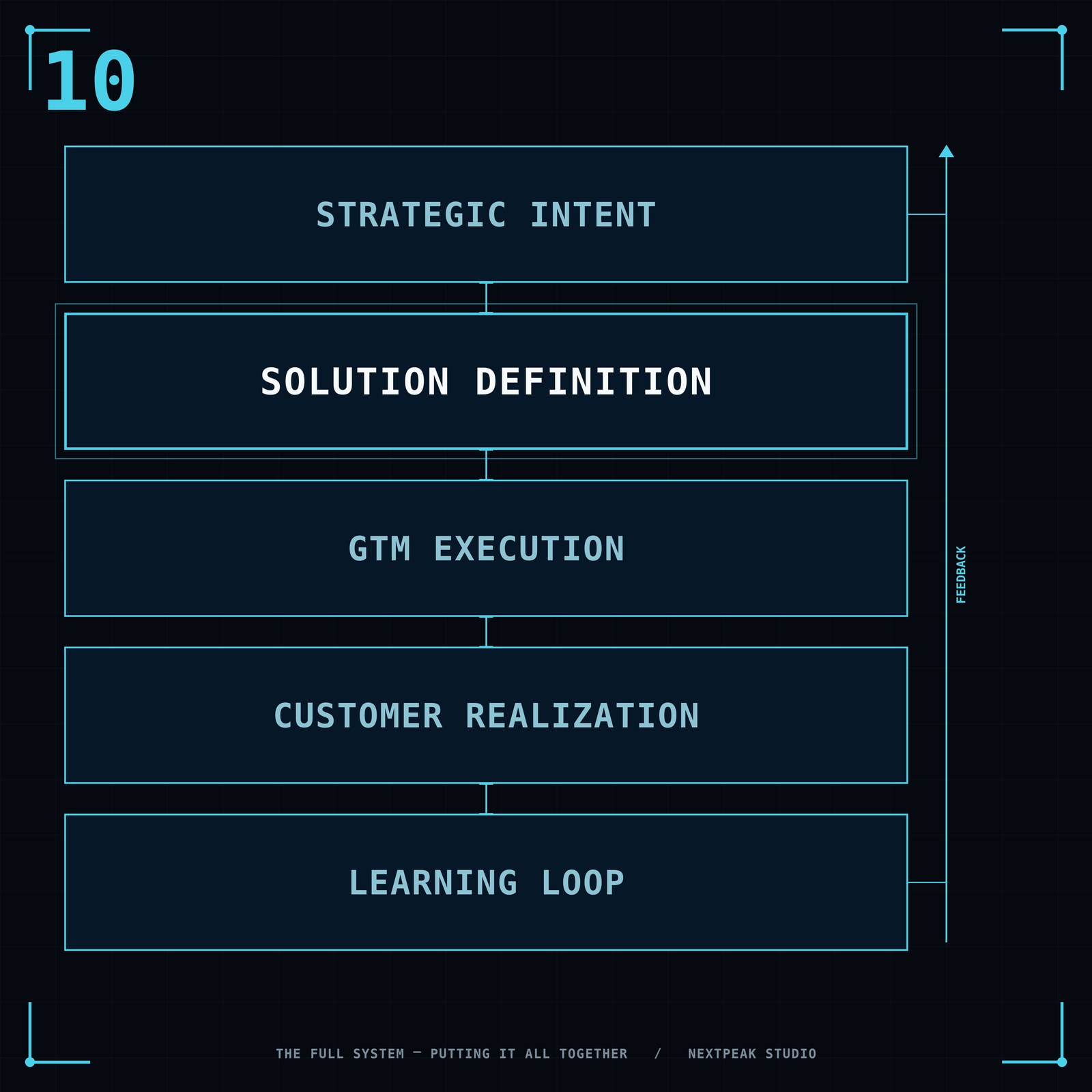
The case for the Customer Solution Brief doesn’t rest on any single thing it changes. It rests on what it changes across the organization simultaneously, and on what becomes possible when all of those changes are operating at the same time. This final post in the series covers that full picture, as an answer to the question leaders ask when they’re deciding whether this is worth doing: what does a company that runs this system actually look like?
Companies that have operational Customer Solution Briefs share a set of characteristics that are visible in their metrics, in their culture, and in the quality of their cross-functional conversations. These characteristics develop over the twelve to eighteen months after the briefs are built and embedded into the operating cadences of the business. They appear reliably when the system is built correctly.
What the System Looks Like in Practice
In the product function, the roadmap conversation stops being a debate about competing opinions and starts being a conversation about investment allocation across defined customer types. Feature requests are evaluated against briefs rather than adjudicated by whoever argues most effectively. Product managers have a shared framework for explaining why something is or isn’t on the roadmap, and that explanation connects to the company’s stated customer type commitments rather than to abstract prioritization principles. New capabilities are described in terms of which customer type they serve and how they advance the value thesis for that type.
In the sales function, the variance between top performers and the rest of the team narrows in a useful direction. Discovery conversations are more consistent because reps are identifying customer types and listening for type-specific signals rather than running a generic qualification process. Demos are more compelling because they’re organized around the value thesis for the customer type rather than around the product interface. Proposals are more credible because they articulate the specific mechanism of value creation rather than restating the general product promise. Win rates in the defined customer types improve as the pattern becomes more consistently executed.
In the sales process, more of the deals that close are deals the company knows how to deliver. Implementation overruns decrease because the accounts that were structurally difficult to serve are identified at the selection gate rather than discovered at kickoff. The implementation team inherits accounts that match the brief’s description of what a deliverable engagement looks like, and the standard delivery path applies more often than the exception path.
In customer success, CSMs manage to a defined baseline rather than to generic activity metrics. They know what a healthy trajectory looks like for each customer type in their portfolio. They can identify at-risk accounts earlier, have more specific intervention conversations, and make more credible cases for expansion and renewal. Onboarding for new CSMs is faster because the accumulated knowledge of the function is captured in the briefs rather than distributed across the experience of individual team members.
In leadership, the cross-functional conversations that used to produce frustration produce alignment, even though not everyone agrees on everything. What changes is that disagreements are now about strategy rather than about whose read on the customer is correct. When product and sales disagree about a capability, the conversation centers on which customer type to invest in and when, instead of whether the customer cares about the capability. When customer success flags a concerning trend in a customer segment, the conversation connects to specific briefs and specific value theses rather than to a generic concern about health scores.
What the System Doesn’t Do
The Customer Solution Brief system isn’t a substitute for good people, good judgment, or a genuinely competitive product. Organizations losing because their product is inferior to alternatives won’t be saved by better operating artifacts, and organizations struggling because of leadership dysfunction or cultural problems won’t be fixed by a documentation system either. The brief works as an amplifier, making good execution more consistent and scalable, but it can’t turn weak execution into strong execution.
The system also doesn’t eliminate the need for judgment in any of the functions it informs. Product managers still need to make hard calls about what to build, sales reps still need to read a room and adapt in real time, and customer success managers still need to build relationships and earn trust. The brief gives them a better foundation for exercising that judgment, without replacing the judgment itself.
And the system doesn’t stay operational without investment. The briefs need to be maintained, the feedback loop needs to operate, and the briefs need to be embedded in the processes, the planning cycle, the deal review, the customer health review, where they’re relevant. Treating the briefs as finished artifacts once they’re built is how they decay, while treating them as living operating documents is how they compound in value over time.
The Decision to Build
The question leaders face when they get to this point in the conversation is not whether the Customer Solution Brief is a good idea. The question is whether it’s worth the investment to build the system now, given everything else competing for attention and resources.
The honest answer is that the investment is modest compared to the returns if the system is built well. Building three to five briefs from existing organizational knowledge is a matter of weeks. Embedding them into sales, product, and customer success processes takes a quarter of deliberate effort. The ongoing maintenance is a function of the feedback loops the organization is already running, things like win-loss reviews, deal debriefs, and customer health reviews, with the addition of a brief update step.
The harder question has less to do with the investment and more to do with the organization’s readiness to be specific. Building briefs forces the organization to commit to answers that informal knowledge has allowed to stay ambiguous: which customer types are you actually building for, how does value work for each of them, and what does success look like? These are questions that everyone in the organization has an opinion about and no one has written down. Writing them down creates alignment where there was ambiguity, and alignment requires that some opinions lose.
That discomfort is productive: it’s the discomfort of an organization getting clearer about what it’s doing and why. Working through it gives companies a shared operating understanding of their business that makes every downstream function more effective, while avoiding it just keeps things comfortable until the costs of that ambiguity become visible, in sales cycles that run longer than they should, in implementations that turn out harder than expected, and in churn that nobody predicted.
The Customer Solution Brief isn’t a complex idea so much as the answer to a simple question that most organizations haven’t taken the time to answer formally: for each distinct customer type inside the ICP, how does the product create value, and what does success look like? The ten posts in this series have explored what happens when you take that question seriously across every function in the business. The answer, in every function, is that the work gets better.
NextPeak Studio works with executive teams at scaling B2B SaaS companies to build and operationalize the Customer Solution Brief system across product, GTM, and customer success. If you’ve read through this series and recognize your organization in the problems it describes, we’d be glad to have a direct conversation about what building this looks like for your specific situation.