
The Customer Solution Brief (Post 8 of 10)
Customer success managers are often described as being responsible for customer health. That framing sounds clear until you ask what health actually means for a specific account, and the answer turns out to be more complicated than it appears. Health scores built from product usage data are common, but they measure activity more than outcomes. QBR frameworks give structure to the conversation without defining what progress toward value realization should look like for each distinct customer type. Engagement models prescribe how often the CSM should talk to the account without saying what those conversations should accomplish.
The result is that customer success, in most scaling organizations, is managed against a health model that is generic where it should be specific. The same score that signals risk for a medical device customer managing audit workflows may be completely normal for a research operations customer still in early adoption of a different capability set. The CSM who knows their accounts well understands this. The CSM who inherited the account three months ago, or who has thirty accounts under management, may be applying the generic model and drawing the wrong conclusions about which accounts need attention and which are fine.
The Customer Solution Brief doesn’t solve the resource constraints of customer success, but it gives every CSM, experienced or new, carrying ten accounts or fifty, a defined baseline for what success looks like for each customer type they manage. That baseline changes the quality of every downstream decision in the function.
What a Baseline Actually Means
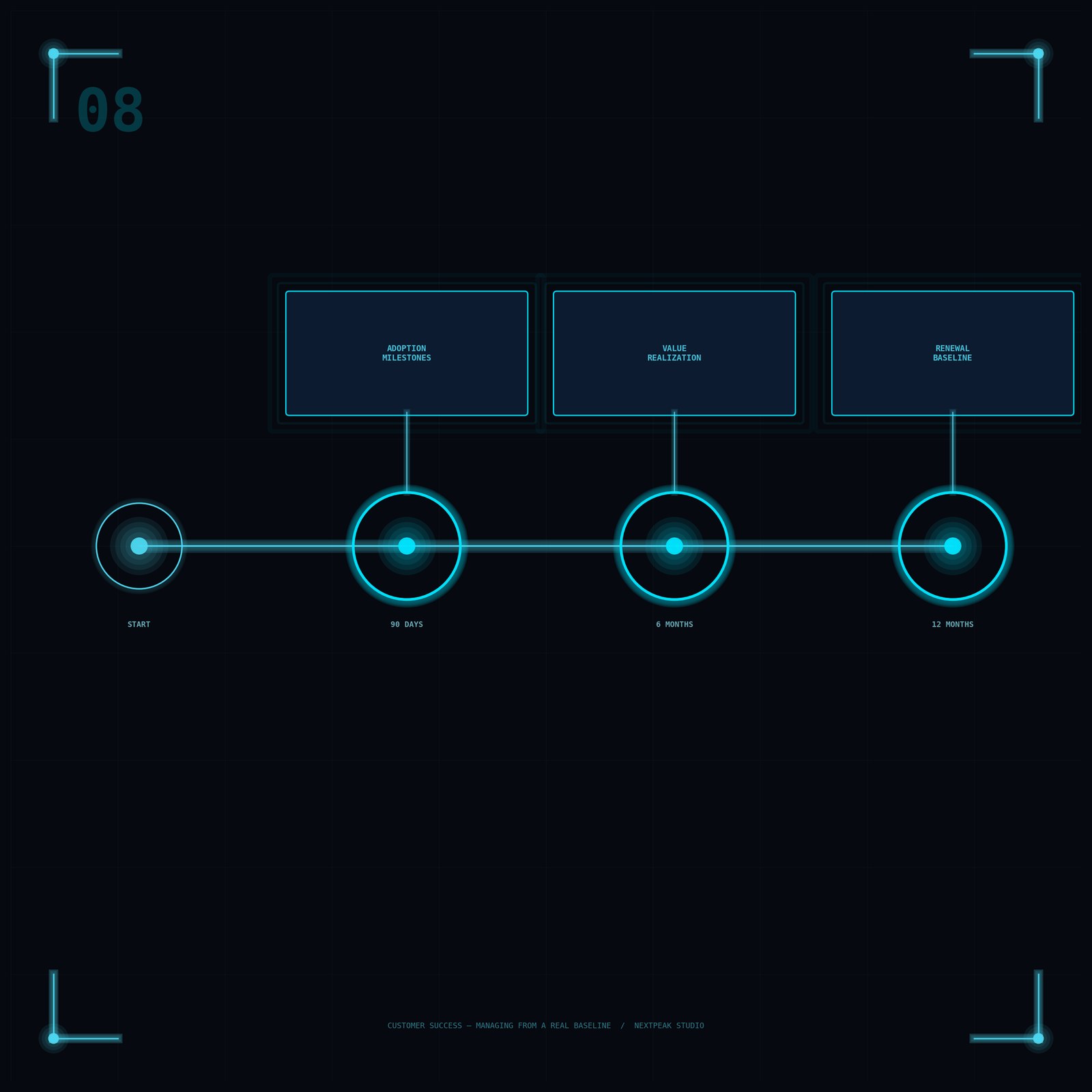
The success definition section of the brief is the most customer-success-specific part of the document, and it’s the section that CSMs find most immediately useful when they first engage with it. It answers three questions that most CS frameworks leave implicit: what does this customer type need to accomplish in the first ninety days to be on a trajectory toward value realization? What does a healthy adoption curve look like at six months? And what signals indicate that an account is drifting away from the value path before that drift becomes churn?
These are not abstract questions. They are grounded in the value thesis for the customer type, which in turn is grounded in the core problem that customer type is trying to solve. The medical device customer’s success definition connects directly to audit readiness: at ninety days, a healthy account should have active users in the quality and compliance roles, should have completed the first round of controlled document migration, and should have at least one approval workflow in production. At six months, audit readiness should be measurable and the CSM should have evidence of it. At twelve months, the customer should be able to demonstrate a material reduction in the time required to prepare audit documentation. If none of those things are true, the account isn’t on track, and that conclusion is available to the CSM without a lengthy diagnostic process because the baseline is already defined.
This specificity matters more as organizations scale. When a CS team has five accounts, the tribal knowledge of the team covers the gap. When it has fifty, or five hundred, that knowledge is unevenly distributed and the gap is covered unevenly. The brief creates a documented baseline that transfers with the account when it changes hands, that onboards new CSMs faster, and that makes performance reviews and account health assessments more consistent across the team.
Expansion and the Brief
The brief’s success definition section is also where the signal for expansion naturally lives. Expansion in most SaaS businesses is driven by three things: the customer succeeding with what they bought, the customer having more of the problem the product solves, and the CSM being able to make a specific case for what additional investment would accomplish.
The brief supports all three. The success definition tells the CSM when the customer has successfully realized the first phase of value, which is the prerequisite for a credible expansion conversation. The customer type definition describes the common patterns of expansion for this type: are they typically expanding by adding seats in the same department, extending to adjacent departments with related problems, or deepening their use of capabilities they’ve already licensed? And the value thesis provides the language for the expansion conversation, what the additional investment would deliver, grounded in the same customer-type logic that made the original sale compelling.
CSMs who are managing from a brief don’t pitch expansion speculatively so much as present it as the natural continuation of a value trajectory the customer is already on. Instead of asking “would you like to do more with us?” the conversation becomes “you’ve accomplished X, which is the first phase of what we mapped out together. The next step in this customer type’s typical journey is Y. Here’s what that looks like for your account specifically.” That conversation is different in character from the standard upsell motion, and customers respond to it differently.
Renewals with Clearer Evidence
The renewal conversation is where the brief’s success definition has the most immediate financial impact. In the absence of a defined baseline, the renewal conversation is often a retrospective of account activity and a negotiation about the value of continued investment. The CSM presents usage data, the customer considers whether to continue, and the outcome depends on whether both sides arrive at the same conclusion about whether the product has been worth it.
When the renewal is managed against a defined success baseline, the conversation is different. The CSM can compare the account’s current state against the milestones the brief defines and present a factual picture of where the customer is on the value trajectory. If the customer has hit the milestones, the renewal case is concrete. If they haven’t, the CSM gets advance warning well before renewal, rather than a surprise at the table, and has had the opportunity to intervene, explain the gap, and either close it or have an honest conversation about fit.
This doesn’t make every renewal easy, but it does make renewal conversations about facts rather than feelings, shifting the CSM from a position of advocacy, arguing on behalf of renewal, to a position of informed partnership, reviewing the evidence together and making a shared decision about next steps. That shift is subtle in language and significant in outcome.
Onboarding New CSMs Against the Brief
One of the operational benefits of the brief that doesn’t get enough attention is what it does for CSM onboarding. Bringing a new customer success manager up to speed on a portfolio of accounts in a scaling organization is expensive and slow. The knowledge is in the heads of the people who built the accounts, and transferring it takes months of shadowing, hand-holding, and making recoverable mistakes.
The brief compresses that timeline significantly. A new CSM who can read the brief for each customer type in their portfolio knows, before their first call with any account, what the value thesis is, what a healthy account looks like, what the common risks are, and what questions to ask. Rather than starting from a blank canvas, they’re starting from the accumulated understanding of every customer the company has served in that type, distilled into a form that transfers in an afternoon rather than a quarter.
That compression is compounding. Organizations that onboard CSMs faster have lower attrition because new team members feel competent sooner. They have better account outcomes because the gap between account transfer and effective management is shorter. And they have a more scalable function because the ceiling on team size is higher when onboarding is efficient.
NextPeak Studio works with customer success leaders to build brief-grounded success definitions and health models that give CS teams a real baseline to manage from at every scale. If your team is managing to activity metrics when they should be managing to value outcomes, the brief is where that changes.