
The Customer Solution Brief (Post 7 of 10)
The deal that looked perfect at signing and became a nightmare at implementation is one of the most consistent and costly patterns in B2B SaaS. The account fit the ICP. The champion was engaged. The economic buyer approved the purchase. The contract was signed. And then, somewhere between kickoff and go-live, it became clear that something fundamental about this customer’s situation didn’t match what the product actually does best. The implementation stretched. Customer success inherited an account that was already struggling. Churn was inevitable.
Post-mortem conversations about these accounts tend to focus on execution: what the implementation team should have done differently, how customer success could have intervened sooner, what additional onboarding resources might have helped. These conversations aren’t useless, but they address the wrong stage of the problem. The account that failed at implementation was often questionable at the time of sale, and the execution failure was downstream of a decision that was made without enough information, or with the wrong information, about whether this customer matched a pattern the company actually knows how to serve.
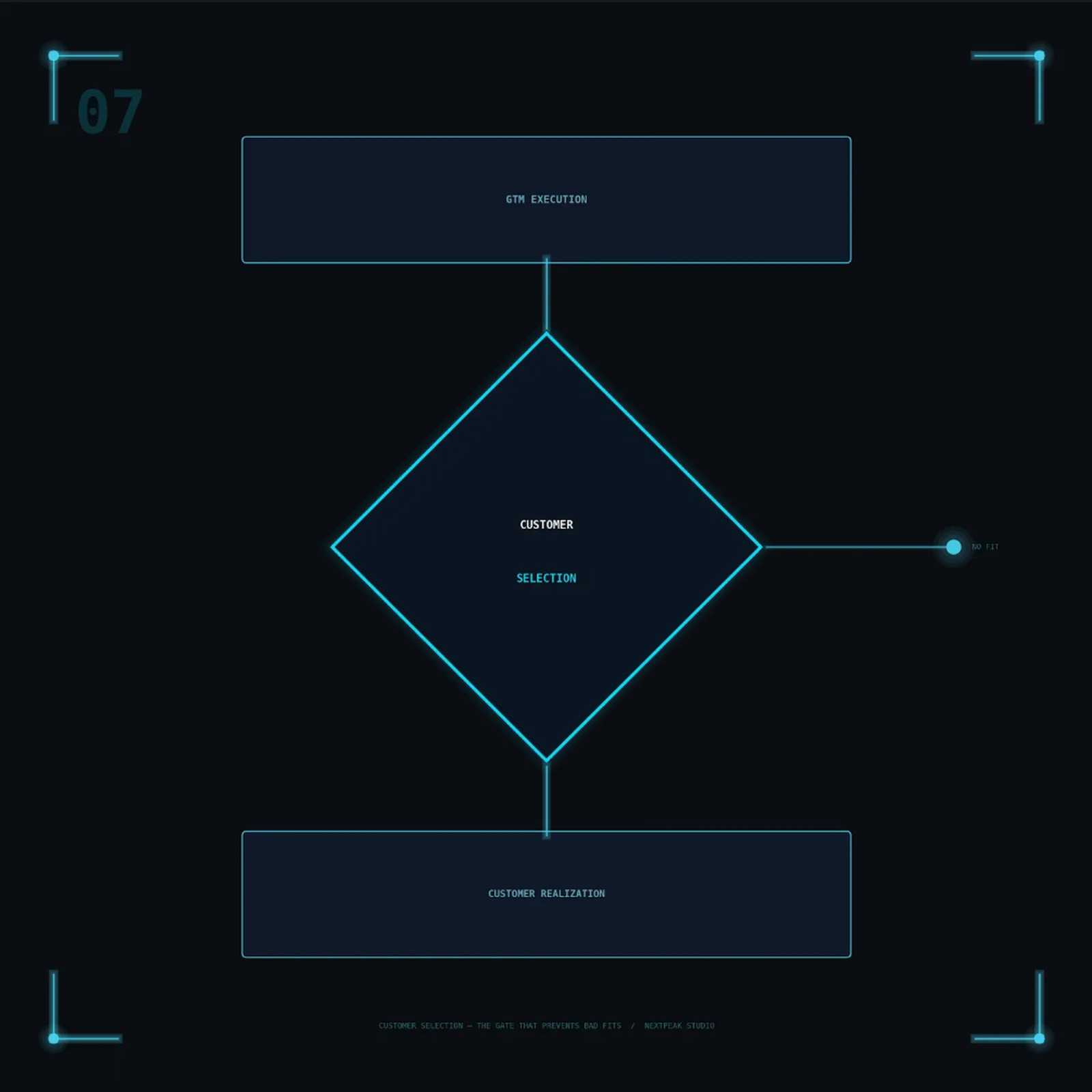
Customer selection is the gate between GTM execution and customer realization. It’s the decision, made before the contract is signed, about whether this account is a genuine fit for a defined customer type. When the solutions briefs are operational, this decision has a standard to be made against. When the solution briefs don’t exist, the selection decision defaults to gut feel, deal size, and pressure to hit the number.
What Selection Actually Means
Customer selection isn’t a binary pass/fail decision so much as a judgment about fit across the dimensions that matter for value realization: does this customer’s core problem match the value thesis of a defined customer type? Does the buyer profile match what the brief expects? Does the implementation context, meaning their technical environment, their internal resources, and their timeline, match what the brief describes as the conditions for successful delivery?
Most companies have some version of a qualification framework that addresses the first few of these questions. BANT, MEDDIC, and their variants are designed to establish whether the buyer has the authority and the budget and whether the timing is real. These frameworks are useful for establishing whether a deal can close, but they say little about whether the customer will succeed after it does. Customer selection asks a different question, one about fit for value realization rather than fit for the transaction.
When the Customer Solution Brief exists, the selection criteria are derived from the brief directly. For each customer type, the brief contains a customer type definition that specifies the profile of the company and buyer that this pattern of value applies to. The discovery conversation, early in the sales process, should surface whether the account matches that profile. The brief also contains implementation guidance that describes the conditions required for a successful deployment. If a prospect is coming in with conditions that fall significantly outside those parameters, say a shorter timeline than the brief describes as viable, an internal team smaller than what the brief identifies as necessary, or a core use case the value thesis doesn’t support, that’s a selection signal as much as an implementation risk.
The Cost of Ignoring Selection Signals
The pressure to close deals is real in every sales organization, and it’s at its highest precisely when the business most needs revenue, in down quarters, in early stages of growth, at the end of a fiscal year. This pressure creates a systematic bias toward rationalizing fit rather than evaluating it. The sales rep believes the account is close enough. The manager backs the rep because the number needs to move. The account gets signed.
The downstream cost of this pattern is substantial and usually invisible in the quarter the deal closes. It shows up in implementation overruns, in higher cost per implementation, longer time to go-live, and more escalations. It shows up in customer success, in more time spent on accounts that are struggling rather than on accounts that could be growing. It shows up in churn, in a cohort of customers who were never going to succeed with the product given the mismatch between what they needed and what the company knew how to deliver. And it shows up in the product roadmap, where feature requests from poor-fit customers create noise that makes it harder to stay focused on the customer types the company is genuinely committed to building for.
None of this is visible as a selection problem at that moment. It’s visible as an execution problem in the quarters that follow.
Building the Gate
The customer selection gate is a structured checkpoint in the sales process, typically before a proposal is issued or a contract is drafted, where the account’s fit against the relevant customer type brief is reviewed explicitly. In smaller organizations, this might be a fifteen-minute call between the sales rep and a senior leader. In larger organizations, it might be a formal deal review with a defined set of selection criteria derived from the briefs.
The review isn’t an interrogation of the rep. It’s a structured evaluation of whether the evidence gathered in discovery supports the fit thesis. The brief defines what a strong fit looks like for this customer type, and the review asks whether the account matches that picture across the dimensions that matter: core problem alignment, buyer profile match, implementation conditions, success definition clarity. Where the match is strong, the deal moves forward. Where there are gaps, the review surfaces them explicitly so the team can make an informed decision about whether to proceed with open eyes about the risk, adjust the scope to match what the brief describes as a viable engagement, or decline the opportunity.
The discipline of the gate is what makes it work. If the gate is bypassed whenever the deal is large enough or the pressure is high enough, it stops being a gate. The best customer selection practices treat the gate as non-negotiable precisely because the deals most likely to bypass it are the deals most likely to become the implementation nightmares of the following quarter.
The Customer Solution Brief creates the standard that the gate enforces. Without the brief, there is no objective definition of what a good fit looks like, and the gate is enforced by experience, intuition, and varying levels of organizational will. With the brief, the standard is written down, shared across the organization, and available to everyone making selection decisions, including people who haven’t yet seen enough cycles to recognize the patterns on their own.
NextPeak Studio helps sales and GTM leadership teams build customer selection processes that are grounded in brief-defined fit criteria rather than instinct and deal size. If your implementation and churn problems are being treated as execution issues when they’re actually selection issues, that’s where we start.