
The Customer Solution Brief (Post 3 of 10)
There is a question that surfaces in nearly every strategic planning cycle at a scaling B2B SaaS company, and it rarely gets answered cleanly: where does strategy actually end and execution begin? Leadership sets direction. Product builds a roadmap. Sales pursues pipeline. Customer success manages retention. Each function is doing its job. But when you look at the outcomes: longer sales cycles, inconsistent implementations, unpredictable churn, something in the connective tissue isn’t holding.
The answer, in most cases, is that the organization is operating without a clear model for how strategic decisions translate into customer outcomes. Strategy and execution are both happening, but they’re not connected through a shared operating structure. The Customer Solution Brief doesn’t solve this problem in isolation. It solves it as part of a five-layer model that describes how decisions made at the strategy level flow through to the outcomes customers experience in the field.
The Five Layers
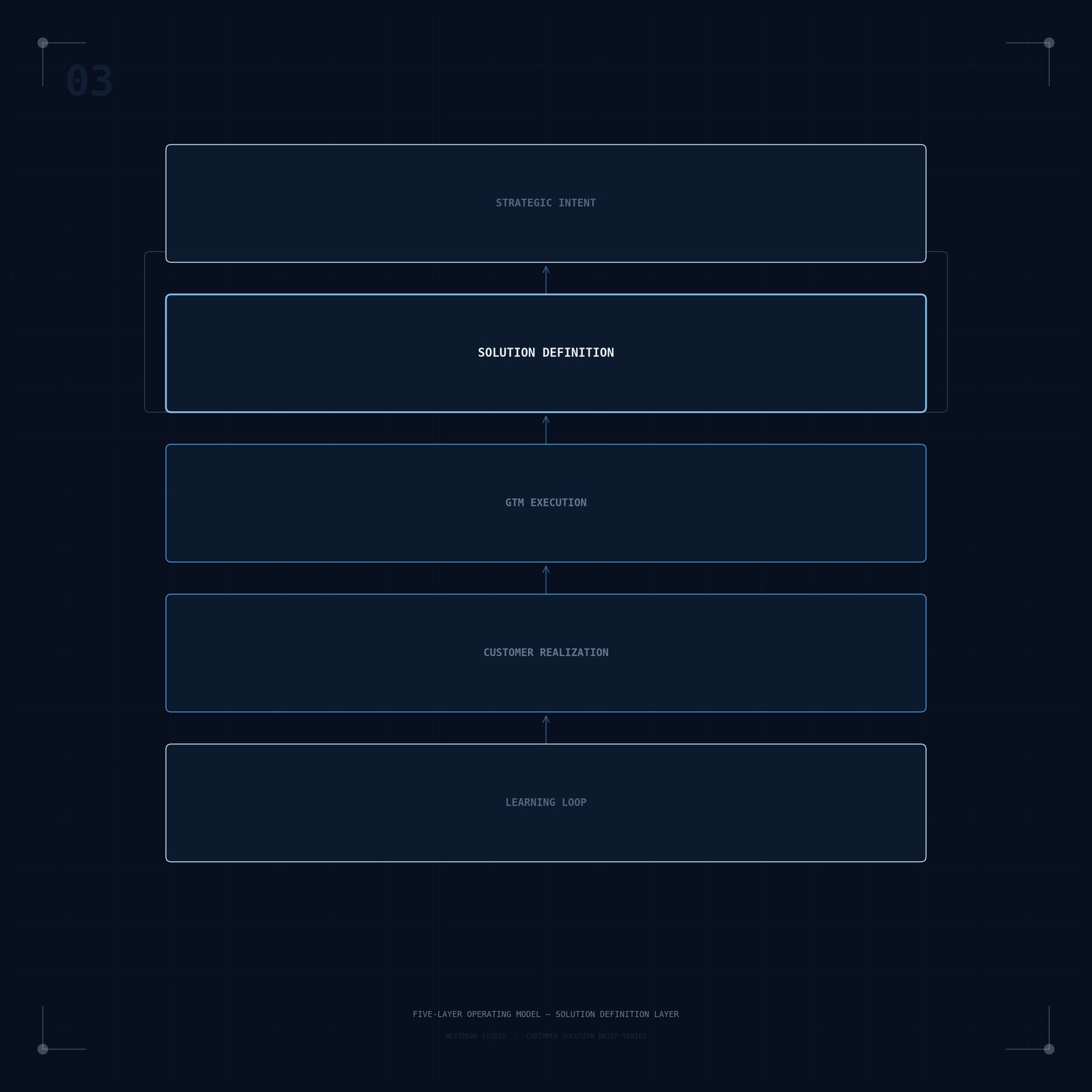
The operating model that makes the Customer Solution Brief functional is built around five layers, each feeding the next. Understanding these layers is what separates companies that use the brief as a living operating tool from those that build it once, put it in a shared folder, and move on.
The first layer is Strategic Intent. This is the company’s answer to why it exists in the market, which problems it has chosen to solve, and for whom. Most companies have some version of this: a market thesis, a founding insight, a strategic plan. The relevant question here is not whether this layer exists but whether it’s specific enough to inform the layers below it. A strategic intent that says “we serve mid-market SaaS companies” is real, but it doesn’t tell anyone which problems those companies have, which of those problems the company is best positioned to solve, or which customer types within that population represent the strongest fit.
The second layer is Solution Definition. This is where the Customer Solution Brief lives. Solution Definition translates the strategic intent, who we’re targeting and why, into the specific value patterns that exist within the target market. It answers the question that strategic intent leaves open: for each distinct customer type inside the ICP, how does the product actually create value? The brief captures this as an operating artifact. The output of this layer is not a slide or a position statement. It’s a working document that every function can navigate and act from.
The third layer is GTM Execution. This is where the brief connects to the sales, marketing, and demand generation motions. When the brief exists and is current, the sales team knows how to run discovery and demo for each customer type. Marketing knows which value thesis to lead with for each segment. The customer selection process, the discipline of deciding which deals to pursue and which to pass, becomes calibrated against the defined customer types rather than against instinct or deal size. Without the brief, GTM execution operates on patterns that vary by rep, by segment, and by quarter, because there’s no shared reference to build from.
The fourth layer is Customer Realization. This is what happens after the contract is signed: implementation, onboarding, adoption, and the point at which the customer actually begins to experience the value the company promised during the sale. Customer Realization is where the distance between promise and delivery becomes visible. When the brief is built well and used consistently across GTM, the customer arrives at implementation with a set of expectations that the implementation team can actually deliver against. When the brief doesn’t exist or isn’t used, each implementation is effectively starting from scratch, and the gap between what was sold and what was delivered tends to be filled with variation, rework, and sometimes churn.
The fifth layer is the Learning Loop. This is the feedback mechanism that keeps the other four layers current. Win-loss patterns flow back to Solution Definition and refine the customer types. Implementation learnings update the brief’s guidance on onboarding. Customer success data on adoption and retention refines the success definitions that the brief captures. Without this feedback loop operating deliberately, the brief gets stale, the GTM motion drifts away from what the market actually rewards, and the organization gradually loses calibration between what it thinks it’s selling and what it’s actually delivering.
Why the Brief Is the Hinge
Most companies have something at the Strategic Intent layer: a stated market focus, an ICP, a positioning framework. Most also have activity at the GTM Execution and Customer Realization layers: sales teams, implementation teams, customer success. What they typically don’t have is the Solution Definition layer functioning as an operating reality rather than an intellectual exercise.
The brief is the hinge between the two halves of the model. Without it, strategic intent sits at the top of the organization and GTM execution operates at the bottom, and the distance between them is covered by informal knowledge, individual experience, and functional improvisation. Sales reps construct the story their way. Implementation teams build the approach that worked last time. Customer success manages accounts the way they know how. None of this is malicious. It’s what happens when the connective layer is missing.
With the brief, Strategic Intent flows into Solution Definition, which flows into GTM Execution, which flows into Customer Realization, which flows back into learning. Each layer knows what it needs from the one above it. Each function can see how its work connects to the customer types the company has committed to serving.
Where Companies Get Stuck
The most common failure mode isn’t that companies don’t understand the model. It’s that they try to skip the Solution Definition layer. They go directly from ICP to execution, from market definition to sales motion, from product strategy to feature development, without the intermediate layer that translates one into the other.
This produces a recognizable set of symptoms. Sales cycles are inconsistent because different reps are running different stories. Product roadmap debates are frustrating because there’s no customer-grounded framework for adjudicating competing feature requests. Customer success is reactive because there’s no defined baseline of what success should look like for each account type. These are all Solution Definition problems wearing execution clothing.
The fix is not to work harder at the execution layer. It’s to build the layer that’s missing. That’s what the Customer Solution Brief is for: creating the solution definition layer that makes every other layer work better. The posts that follow in this series examine each of those downstream layers in operational detail: how the brief changes product prioritization, how it reshapes the sales motion, how it changes the customer selection process, and how it gives customer success something real to work from.
NextPeak Studio builds and operationalizes this model with executive teams at scaling B2B SaaS companies. If your organization is working hard at the execution layer but not getting the outcomes it expects, the gap is almost always upstream. That conversation is worth having directly.