
Alignment Is the Job to Be Done
Most leadership teams already use OKRs. However, alignment still feels fragile. Teams stay busy. Roadmaps stay full. Decisions keep escalating. Each planning cycle starts with the same conversation about priorities. That pattern points to a system design issue.
OKRs fail when they are treated as a goal-setting mechanism. They work when they function as an alignment system that connects strategy to daily decisions. In the prior post in this series, we covered why roadmaps fail to create alignment on their own. They show what teams plan to build, but they do not show why those choices matter now. OKRs are meant to close that gap.
When they do not, leaders feel it quickly. Teams optimize locally. Tradeoffs get revisited repeatedly. Strategy conversations repeat every quarter. Execution speeds up while clarity erodes. This shows up even in strong organizations. The failure sits in how objectives are defined and how alignment flows through the company.
What an Objective Actually Represents
An objective is a strategic bet for a defined period of time. It signals where leadership attention goes, which tradeoffs are acceptable, and which decisions teams should be able to make without escalation. Objectives declare intent. Key results show evidence of progress. Tasks belong somewhere else.
Many OKR systems fail here. Objectives drift into themes, slogans, or disguised task lists. That removes their decision-making power. A simple test is useful: if an objective does not help a team decide what to deprioritize, it is not doing its job.
The Alignment Spine
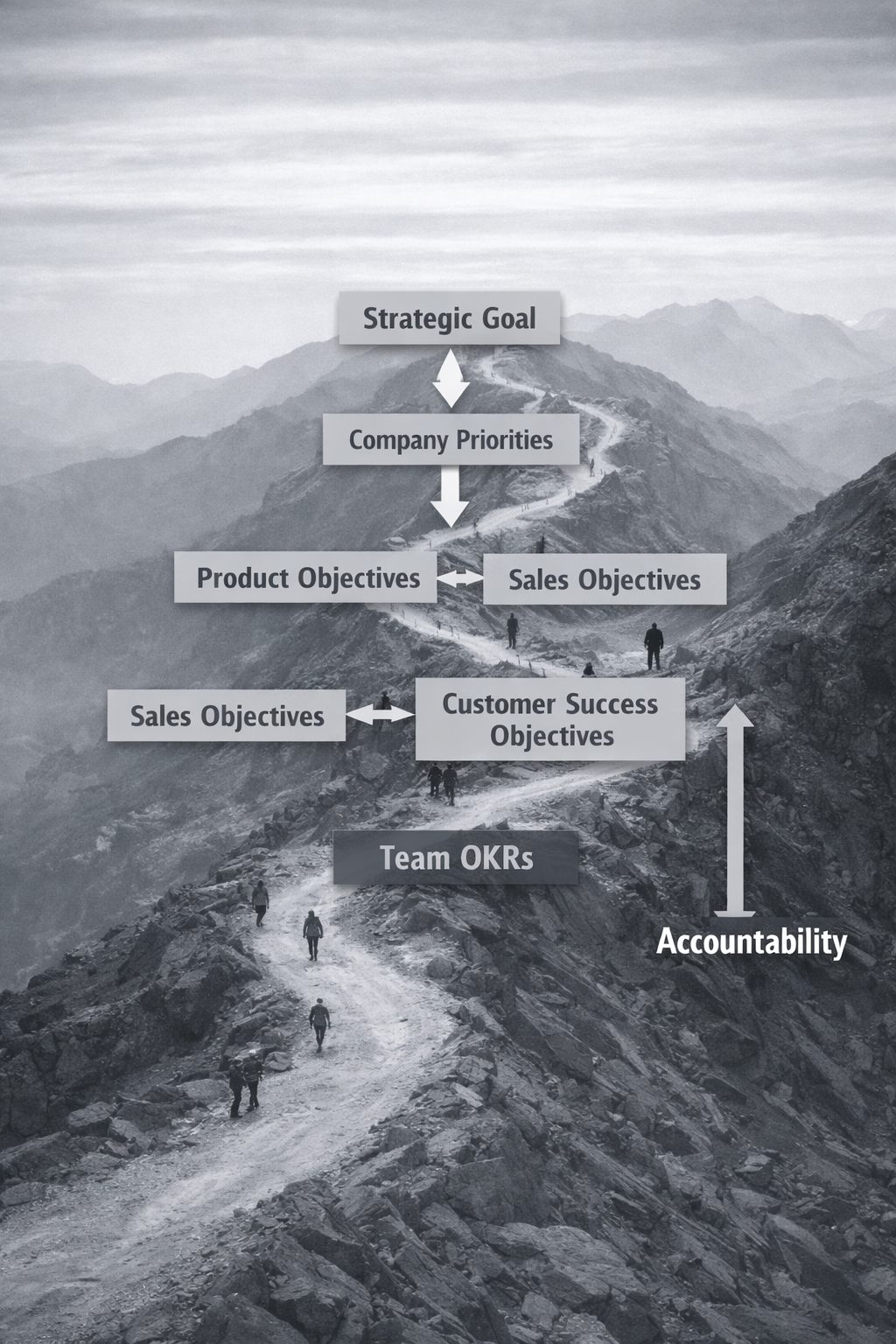
Alignment works when there is a clear spine through the organization. Leadership defines a small number of company-level priorities that reflect the real strategic bets for the period. Functions translate those priorities into domain-level objectives. Teams express execution through their own OKRs, anchored to the same intent. Direction flows downward and accountability flows upward.
Teams do not create alignment on their own. They inherit clarity from leadership. However, they can inherit confusion from leadership as well. A single company priority should show up differently across Product, Sales, and Customer Success. That variation is healthy.
Where OKR Systems Quietly Break
Most OKR failures look reasonable in isolation and damaging in combination. Common patterns include too many objectives at every level, identical objectives copied across teams, key results that measure activity or volume instead of outcomes, teams setting OKRs before company priorities are clear, and quarterly resets that ignore longer-term bets.
Each pattern adds noise. Together, they erode trust in the system. Leaders compensate by stepping in more often. Decisions escalate. Alignment becomes conversational rather than structural.
Where OKRs Are Successful
A healthy OKR system creates clarity under pressure. It forces visible tradeoffs, clarifies what matters most now, reduces unnecessary escalation, improves decision quality at the edges, and holds leaders accountable for focus. A useful test is to ask a team to explain how their OKRs support company priorities in one minute. If that explanation is fuzzy, alignment is already compromised.
Alignment Comes Before Execution
OKRs on paper do not survive delivery pressure. Alignment has to show up in reviews, resourcing decisions, and leadership behavior. The next post in this series will focus on operationalizing alignment: cadence, reviews, and leadership habits that keep OKRs working once the quarter gets messy.
This blog series explores alignment from three angles: why roadmap-driven planning breaks under pressure, how OKRs create clarity when designed as an alignment system, and how leadership behavior sustains that clarity during execution. Alignment weakens when intent, tradeoffs, and daily decisions drift apart. When leaders treat alignment as an operating discipline and reinforce it through structure and behavior, OKRs become a durable bridge between strategy and execution.
If you are navigating alignment challenges in your own organization and want a practical perspective on how to strengthen them, reach out to NextPeak Studio to discuss how we can help.